 Peekwick
Essaouira
Marrakech · Monuments and palaces · about 6 h
From Purple Dye to Mogador
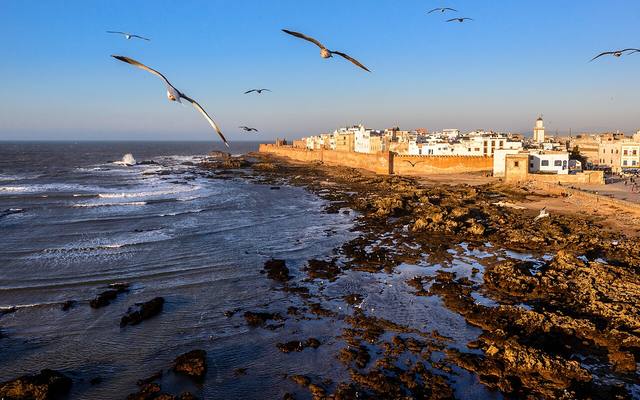
The site of Essaouira has been occupied for a very long time. At the end of the first century BC, the Berber king Juba II had a purple dye workshop set up here. Purple is a reddish-violet dye, rare and expensive, drawn from shellfish called murex. They were gathered on the coastal rocks and on the islands that close the bay, now called the Purple Islands. Much later, in 1506, the Portuguese built a fort on the coast, but they left as early as 1510 in the face of the residents' resistance. The town was long known as Mogador, a name Europeans used until the twentieth century. This very ancient past is a reminder that the bay, partly sheltered by Mogador Island, has always served as a refuge for ships. The name Essaouira took over after Morocco's independence. It is sometimes translated as the well-drawn, which fits its regular plan.
In the app, this story goes on for 5 parts, to read or listen to, with one voice for grown-ups and another for kids.
A Town Drawn With a Ruler
Imagine a town drawn with a ruler by an engineer, beside the ocean, with huge ramparts and bronze cannons pointing at the waves. That is Essaouira, in Morocco. It was built more than two hundred fifty years ago, in the 1760s, by a sultan who wanted a great port. The architect was French, his name was Théodore Cornut, and we owe him the grid plan, with straight, regular streets. Around the town, everything is protected by a thick wall, called a rampart. You walk on top of it, look at the sea, and think of the soldiers who watched over the ocean.
In the app, this story goes on for 7 parts, to read or listen to, with one voice for grown-ups and another for kids.

The full stories, the audio, the offline map and the challenges for kids.