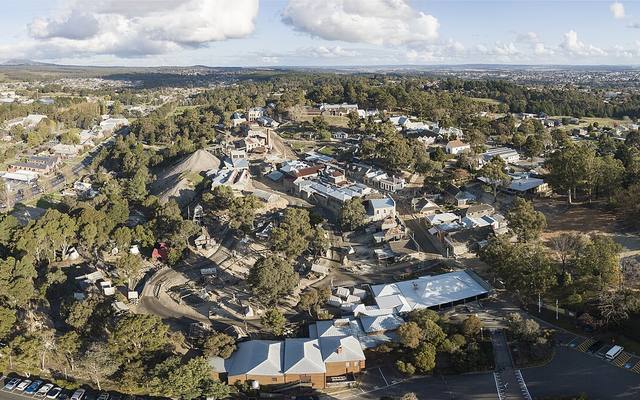
Ballarat lies on the lands of the Wadawurrung people, who lived here long before the arrival of Europeans and the gold rush. In August 1851, an English blacksmith, Thomas Hiscock, found gold near Buninyong, a nearby small town. Later that same month, John Dunlop and James Regan found some at Poverty Point, the hill of poverty. This place is now called Golden Point. Thousands of gold diggers joined the valley of the Yarrowee River. Around 1858, Ballarat had nearly sixty thousand residents, many of whom had come to dig. Across the State of Victoria, the European population rose from about ninety-seven thousand people in 1851 to more than five hundred thirty-eight thousand in 1861. For the Wadawurrung, this rush deeply changed the river and the land.
In the app, this story goes on for 7 parts, to read or listen to, with one voice for grown-ups and another for kids.
The First Gold Digger
Listen to the start · kids' voice0:00 / 0:35
The story goes that the gold of Ballarat was found by one man, a blacksmith. It is a simple story, and the truth is more complicated. His name was Thomas Hiscock, and in August 1851, he really did find gold near Buninyong, a nearby small town. But later in the month, John Dunlop and James Regan also found gold, on a hill called Poverty Point, the hill of poverty. In 1854, it was hard to decide who had started it, because the discoveries followed one another so closely. Today, that hill is called Golden Point.
In the app, this story goes on for 7 parts, to read or listen to, with one voice for grown-ups and another for kids.
TipThe site is open Tuesday to Sunday, from ten a.m. to five p.m., and every day during Victorian school holidays. It is generally closed to the public on Mondays in school term, except public holidays, and on Christmas Day. For general admission, expect about sixty-eight Australian dollars per adult and forty-three per child from five to fifteen, or about one hundred ninety dollars for a family of four. Entry is free under five. The VIP Rebellion Pass, at about one hundred three dollars per adult and fifty-eight per child, adds a two-hour guided tour and a reserved gold-panning spot. In June and July, during Winter Wonderlights, you need a special ticket that includes entry. General admission includes gold panning in the creek, the free self-guided Red Hill mine and the gold pours. The guided tour of the Sovereign Quartz Mine and the costume portraits cost extra. AURA, the evening show, takes place several evenings a week, and every evening during school holidays. Sessions start as early as seven p.m. from April to October, and up to nine fifteen p.m. in December and January. You must book in advance, arrive at least fifteen minutes early, and expect about forty-five dollars per adult and twenty-four per child from five to fifteen. The session lasts about an hour and a half, partly outdoors in all weather. Bring warm clothes, and check the last train to Melbourne before booking, or stay overnight in Ballarat. Gold pour times change with the season: check them on arrival. For food, look for the Hope Bakery on the map, and wear good shoes for a full day on foot. The Eureka Centre Ballarat, formerly the Museum of Australian Democracy at Eureka, keeps the Eureka flag and is a little over two kilometers away. It is open every day from ten a.m. to five p.m., except Christmas Day and the day after. Entry costs about seven dollars per adult and five per child. Information checked in October 2026, to be confirmed on the official website.
The whole visit in the app
The full stories, the audio, the offline map and the challenges for kids.
 Peekwick