 Peekwick
Navigli and Darsena
Milan · Navigli, Porta Ticinese, and Tortona · Neighborhoods, parks, and views · 1 h 30
A city of water without a river
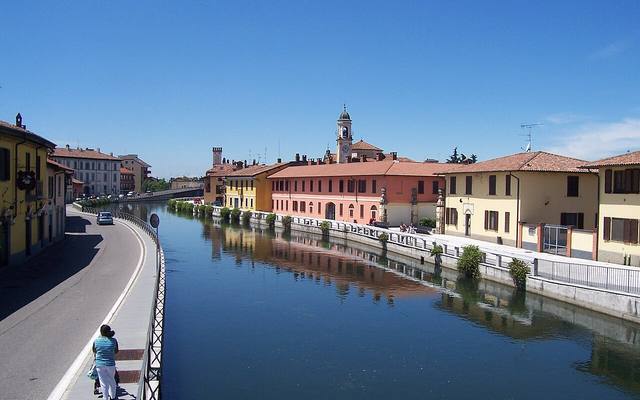
Milan has no river. So Milanese people dug canals, the Navigli. The oldest is the Naviglio Grande. Work began in 1177, and the water reached Milan in 1258. It became navigable in 1272, after works to widen it. It takes its water from the Ticino, near Tornavento, and runs nearly fifty kilometers to the city. In the fifteenth century, the Martesana linked Milan to the Adda. A ring of canals, the Cerchia, then surrounded the center. The Naviglio Pavese, toward Pavia and the Po, was only finished in 1819. Milan was thus linked to the lakes, the Alps, and the Adriatic Sea. The canals also irrigated the fields, and that is still their role today.
In the app, this story goes on for 5 parts, to read or listen to, with one voice for grown-ups and another for kids.
Three letters on a barge
What do the three letters A, U, F painted on this barge mean? Answer in a moment. It is 1400, and you are on board, on a quiet canal. A horse walks on the path along the water, pulling your boat with a rope. Behind you, enormous blocks of pink marble. They come from the mountains near Lake Maggiore, and they will be used to build the Duomo. The trip lasts several days. The three letters mean that this marble is for the cathedral, and that it pays no tax. The canal you see today is the same one!
In the app, this story goes on for 5 parts, to read or listen to, with one voice for grown-ups and another for kids.

The full stories, the audio, the offline map and the challenges for kids.