Peekwick
Arc de Triomphe
Paris · The Champs-Élysées, Concorde and Trocadéro · Monuments · about 1 h
A promise from Napoleon
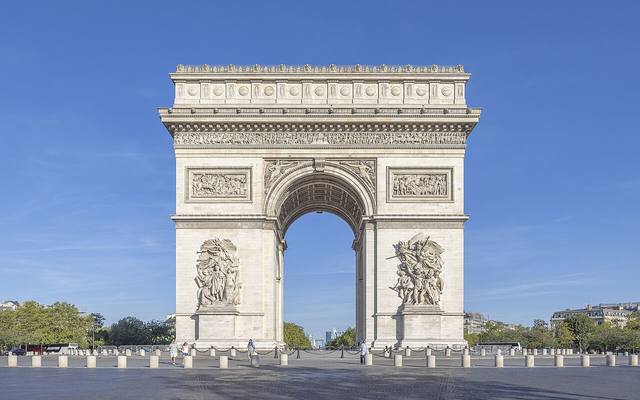
On February 18, 1806, the day after his victory at Austerlitz, Napoleon ordered a triumphal arch built to honor his Grande Armée. The architect Jean-François Chalgrin took his inspiration from the Arch of Titus in Rome, but made it much bigger. Work moved slowly. In 1810, for the arrival in Paris of his new wife Marie-Louise, Napoleon had a full-size model hastily put up in wood and painted canvas, since the arch was not finished. Chalgrin died in 1811, the Empire fell in 1815, and the site shut down. Work resumed under the Restoration, and the arch was inaugurated on July 29, 1836, by King Louis-Philippe, thirty years after the decree. Napoleon only passed under it in 1840, in his coffin, when his ashes came home.
In the app, this story goes on for 5 parts, to read or listen to, with one voice for grown-ups and another for kids.
An emperor's promise
In 1806, Napoleon had just won a great battle at Austerlitz. He promised his soldiers that they would come home under triumphal arches, like Roman generals. He ordered the biggest one ever built, at the top of the Champs-Élysées. But the work was so slow that four years later, when his new wife arrived in Paris, the arch was still not finished. So Napoleon had a fake arch made in a few weeks, out of wood and painted canvas, at full size, to fool everyone! The real arch was only finished in 1836, thirty years after the promise, and Napoleon had been dead for a long time.
In the app, this story goes on for 5 parts, to read or listen to, with one voice for grown-ups and another for kids.

The full stories, the audio, the offline map and the challenges for kids.