Peekwick
Castel Sant'Angelo
Rome · Vatican and Castel Sant'Angelo · Vatican · 1 h 15
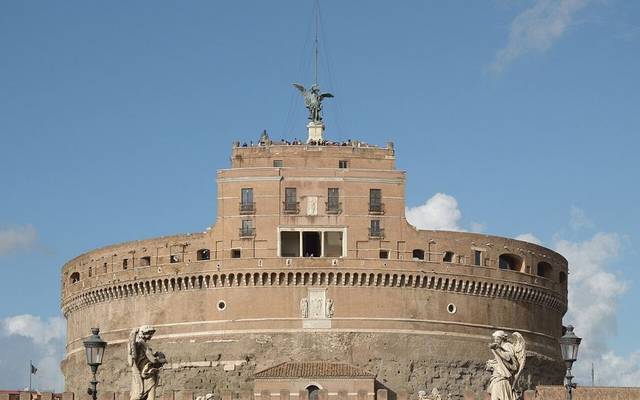
Hadrian's mausoleum
Around 135, Emperor Hadrian, who built the Pantheon and the wall that bears his name in northern England, began work on his own tomb. He had it raised on the right bank of the Tiber, facing the Campus Martius. His successor Antoninus Pius finished it in 139, a year after Hadrian's death. On a square base nearly ninety meters on each side rose an enormous cylinder sixty-four meters across, faced in marble. It was crowned with a mound of earth planted with cypresses and a bronze four-horse chariot driven by the emperor. A spiral ramp one hundred twenty-five meters long climbed to the chamber of the urns, where the ashes of the emperors were placed until Caracalla, in 217. The Aelian Bridge, today's Sant'Angelo Bridge, was built in 134 to lead to it.
In the app, this story goes on for 5 parts, to read or listen to, with one voice for grown-ups and another for kids.
From tomb to castle
Can a tomb turn into a castle? It happened right here. At first, it was a tomb so huge it looked like a mountain of white marble, with a garden of cypress trees on the roof. At the very top, a statue of the emperor stood on a chariot with four horses. This is how Emperor Hadrian wanted to sleep for eternity. But Rome needed a fortress, so people tore off the marble, blocked the openings, and added walls, towers, and cannons. The tomb became a castle, then a palace for the popes, then a prison, and today a museum where you can climb all the way to the top.
In the app, this story goes on for 7 parts, to read or listen to, with one voice for grown-ups and another for kids.

The full stories, the audio, the offline map and the challenges for kids.