 Peekwick
Suwon Hwaseong Fortress
Seoul · Palaces, Temples, and History · 4 h 30
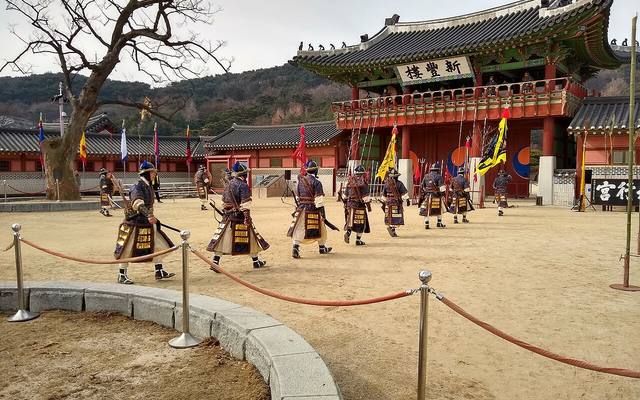
A father's tomb
King Jeongjo reigned from 1776 to 1800. His father, Crown Prince Sado, had died in 1762 in tragic circumstances, after a conflict with King Yeongjo, his own father. In 1789, Jeongjo had Sado's tomb moved near Suwon, about thirty kilometers south of Seoul. He had a temporary palace built there, the Haenggung, where he stayed during his visits to the tomb: he went there thirteen times. Five years later, in 1794, he launched the construction of the fortress. It was meant to honor the memory of his father, but also to make Suwon a new and prosperous city. Jeongjo seems to have thought of moving the capital there one day, and he offered residents who settled there a ten-year tax exemption.
In the app, this story goes on for 7 parts, to read or listen to, with one voice for grown-ups and another for kids.
The king who wanted a wall
His name was Yi San, and in 1776 he became King Jeongjo. His father, Prince Sado, had died in 1762, when Yi San was still a child. Once he became king, Jeongjo wanted to honor his memory. He moved his father's tomb to Suwon, about thirty kilometers from Seoul. Then he had a huge idea: to build a whole city surrounded by a wall. Work began in 1794 and ended in 1796. That is less than three years for a wall of nearly six kilometers! Today, you walk on this giant construction site.
In the app, this story goes on for 7 parts, to read or listen to, with one voice for grown-ups and another for kids.

The full stories, the audio, the offline map and the challenges for kids.