 Peekwick
The Tamil Quarter and Its Verandah Houses
Pondicherry · Tamil Quarter, Temples and Markets · Streets, Markets and Views · 1 h 30
Two Towns Face to Face
Pondicherry was for a long time two towns side by side. In the east, along the sea, lay the town of the Europeans, now called White Town. In the west stretched the town of the Indians, which the French called the Black Town and which is now called the Tamil Quarter. Between the two runs the Grand Canal. Originally, it was a drainage canal for rainwater, but it also served as a border, because the colonial administration separated the districts by the origin of the residents. The grid plan of the streets was drawn by the Dutch between 1693 and 1699, and the French completed it after 1700. In 1761, the English razed almost the whole town. It was rebuilt on its old foundations, and by 1768 a large part of the old Pondicherry you still see was rebuilt.
In the app, this story goes on for 7 parts, to read or listen to, with one voice for grown-ups and another for kids.
A Veranda for the Neighbors
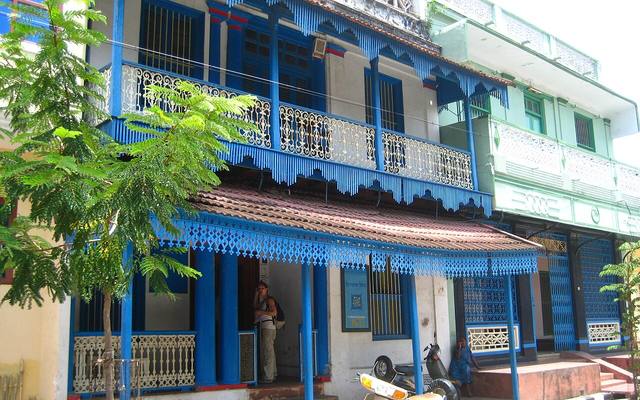
Your house has a door, and maybe a doormat in front. In the Tamil Quarter, before the door, there is a veranda with a sloping roof set on wooden posts. And under this veranda, there is a stone bench attached to the house: the thinnai. Neighbors sit there to chat, and travelers can rest there. Pilgrims, who walk toward the temples, stop there too. It is as if the house held out a hand to the street.
In the app, this story goes on for 6 parts, to read or listen to, with one voice for grown-ups and another for kids.

The full stories, the audio, the offline map and the challenges for kids.