 Peekwick
Aveiro and Costa Nova
Porto · Monuments · about 3 h
Salt, Lagoon, and Inlet
Aveiro was built on the edge of a lagoon, the ria. A long sand barrier, about forty-five kilometers long and at most two and a half kilometers wide, protects it from the ocean. The name of Aveiro already appears in the 959 will of Countess Mumadona Dias, who also founded the castle of Guimarães. The region was known for its salt, and the town was long the Portuguese capital of salt. In the fifteenth century, it also lived off cod fishing. Then, during the winter of 1575, a violent storm closed the entrance to the lagoon, and the port silted up. The town went through a long decline. In 1759, King Joseph I nonetheless gave it the rank of city. In 1808, the inlet to the ocean was reopened and fixed with dikes, built with stones from the old walls. The town regained the sea, and its canals could fill with boats again.
In the app, this story goes on for 6 parts, to read or listen to, with one voice for grown-ups and another for kids.
The Last Seaweed Boats
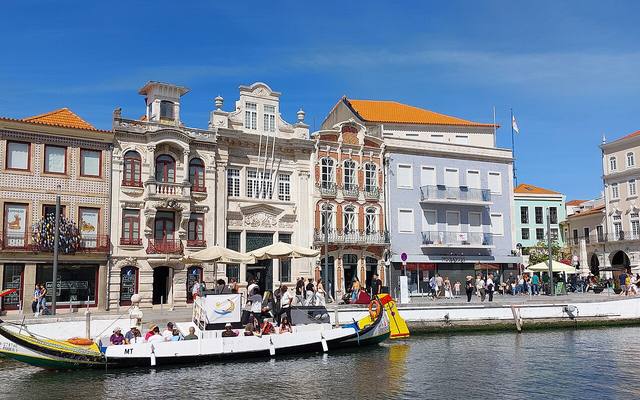
Fifty. That is roughly the number of moliceiros still around in Aveiro. At the start of the twentieth century, there were more than a thousand. These boats look like Venetian gondolas, but they are painted in bright colors and their front curves up to a point. They are about fifteen meters long. Long ago, they were used to gather sea plants in the lagoon, the moliço. Farmers spread them on their sandy fields so crops would grow better. Today, half of the moliceiros take visitors along the city canals. You may even get to ride on one.
In the app, this story goes on for 7 parts, to read or listen to, with one voice for grown-ups and another for kids.

The full stories, the audio, the offline map and the challenges for kids.