 Peekwick
Place de la Bastille
Paris · The Marais and Bastille · Squares and gardens · 20 min
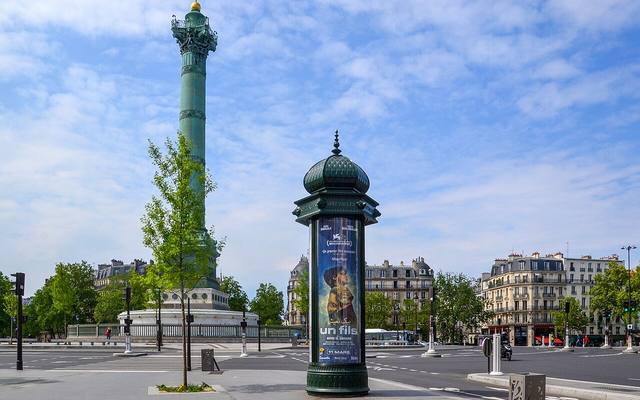
The prison that no longer exists
On July 14, 1789, the Paris crowd seizes the Bastille fortress, a dreaded royal prison. This day marks the symbolic start of the French Revolution and has since become the national holiday of the country. The prison is torn down in the following months by a contractor named Palloy, who even sells stones and models of the Bastille as souvenirs. Today, only an outline on the ground, made of paving stones of a different color, marks the exact spot of the vanished fortress. Other remains exist. On the Line 5 platform at the Bastille metro stop, you can see a section of the moat wall, found during the work of 1899. The foundations of the Liberty Tower, one of the eight towers, were rebuilt stone by stone in Square Henri Galli, across from the Sully-Morland metro stop. The contrast between the violence of that moment and the calm of the square today always surprises attentive visitors.
In the app, this story goes on for 5 parts, to read or listen to, with one voice for grown-ups and another for kids.
A prison stormed
It is July 14, 1789, more than two hundred years ago. An angry crowd storms a huge prison, feared by all Parisians, at the exact spot where you may be standing today. This event became so important that it is celebrated every year in France, on the national holiday. The prison was then completely torn down, stone by stone, until it disappeared entirely.
In the app, this story goes on for 5 parts, to read or listen to, with one voice for grown-ups and another for kids.

The full stories, the audio, the offline map and the challenges for kids.
Read next
 Ideas and tipsCatacombs and underground sights in Europe to visit with kids: Rome, Paris, Vienna, PragueCatacombs in Rome and Paris, the sewers, an underground lake near Vienna, the Kutná Hora ossuary: which underground visits suit kids, and how to prepare them.November 12, 2026
 Ideas and tipsThe best museums for kids in Europe's big citiesWhere can children touch, play and experiment? Our pick of kid-friendly museums in Rome, Paris, London, Berlin, Vienna and Amsterdam, sorted by age group.October 29, 2026
 EventsParis at Christmas with kids: what to do over the holidays in 2026Department store windows, lights, Christmas markets, ice rinks and what is open or closed on 24, 25 and 31 December and 1 January: Paris with kids at Christmas 2026.October 23, 2026